Entries Tagged as 'narrations'

voiceover defined

announcer

The great thing about being asked “what do you do for a living?” is telling people that I am a voice over talent which often times is followed up by “what’s a voice over talent?” I get to tell them about my business because they asked me…I didn’t force explaination on them. That is a sales person’s dream!

The bad thing about that scenario is how often it happens and how monotonous the explaination can feel after a while.

Well leave it to voice talent and teacher Bettye Zoller to spend the time to define it for all of us so we can just send people to a web site after they back up the Brinks truck with the oodles of money they’re going to pay us for our voice over talent.

I really enjoyed the part where she rattled off examples of the type of work we do because I often forget a few:

Voiceover talents today are hired to narrate audio books, anime, cartoons, videos, films, and cable TV programs. They are the voices of toys, talking picture frames, cell phone messages, talking greeting cards, your car’s GPS navigation system, and everything else that’s manufactured with a computer chip inside of it on which a voice track can be stored and played. Voiceover talents greet you (and annoy you!) on thousands upon thousands of those pesky recorded telephone messages and IVR systems. They talk to you through ceiling speakers while you shop in stores. You hear voiceover talents trying to convince you to buy cosmetics at your department store on a video playing over and over (looping) next to those expensive cosmetic products! The military uses voiceovers in training projects and the educational field also uses voice actors for educational endeavors. Nearly every classroom today, kindergarten through post-graduate study in universities sports a large TV monitor in a corner on which educational videos are played. Sometimes, it seems that a teacher doesn’t talk very much anymore. Rather, schools teach a majority of the time with videos.

Thanks Bettye for taking the time to slap that together. You can read the whole article here if you like.
a better commercial voice demo

ear

There are some voice talents for whom it’s a stressful process but I really enjoy the process of producing voice over demos. I love reviewing the work, picking which cuts to use, freshening some segments that were poorly produced (and making the voice sound better) and then of course, the fun of picking the order. It’s a really enjoyable process.

Except when it’s my voice over demo that I’m working on.

Don’t misunderstand, I still like the process but the challenge of the effort when it’s your own work is tougher. Why? Because as voice talents we are each too close to our own work to be as objective as we can be for others. We voiced the spots or narrations, maybe we even produced the final production; the client paid us so they must have liked it, it must have been good, maybe even good enough for the demo reel. Or is it?

Look, the demo is the VO’s calling card, our billboard on the audio super highway, and it can be the difference between getting a job and not getting a job. It’s between 1-2 minutes that will decide “feast or famine”.

For my new commercial demo, I knew there were some spots I wanted to add that I just hadn’t gotten around to putting in. There was a national spot for Shell Oil Company and a big regional spot I did for the New Jersey Board of Tourism that I felt should be included, among others.

While as a demo producer I know how to produce great demos…I also know how much I can either “not hear” or “over hear” in my own work. Mistakes in either direction can lead to a “famine” demo.

I needed to call for backup.

The key to this back up process is to go to a set (or sets) of ears you trust. You need to understand your backup’s experience in audio production, voice over and demo production. A great set of ears has respected credentials in all those areas. In this instance, my backup does what I have often done for personal friends in the biz which is to actually re cut the demo into the order that might work better. On my demo, my back up made the right changes, in my opinion.

So as not to over step the favor my back up offered on my demo and risk a deluge of requests of him for demo help, I’ll merely say thanks Frank for your help (there’s only about 250 Franks in the VO biz so good luck sifting through them).

Give this new demo a listen and let me know what you think (it’s OK if you want to critique it).

a narration of our history

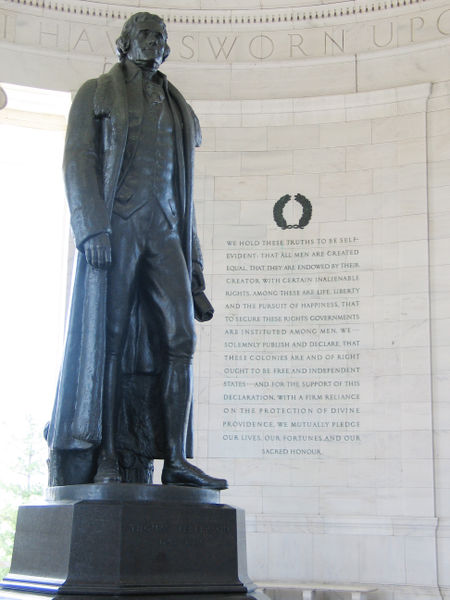
Thomas Jefferson Memorial, Washington DC

I have been asked to quote on a character narration voice over project for a documentary that involves the voices of some of America’s founding fathers. As an expert in this topic I am an abysmal failure but I have, none the less, always been drawn to the writings and lives of some of these extraordinary men.

There are far more erudite students of American history who can share better insight than I can on the lives of John Adams or Thomas Jefferson but because this voice over job got me to thinking about my peculiar fascination with some of these historical figures, I’ll share with you how I have come to enjoy American history, my way.

If you’ve never been to Washington, DC, shame on your sorry ass. If you’re an American citizen, double shame! Yes, it’s a town with a grossly high concentration of liars and thieves but it is also the place where most of the important people and important decisions that have impacted America’s existence have taken place. The monuments, the documents, the very seed of your inalienable rights are in Washington, DC and you must go.

When you do, speaking of inalienable rights, you must go to my favorite monument, The Thomas Jefferson Memorial. It is magnificent by day and it is magical at night. It is said that when it was built on the Potomac River Tidal Basin during Franklin Roosevelt’s presidency, he wanted the statue of Jefferson to face towards the Oval Office and the residence balcony in the White House so that FDR might be inspired and draw strength. It worked, I think. And oh, could Mr. Jefferson write! Some of his marvelous writings adorn his monument and they are thrilling. Rush to get there, stay as long as you can.

One of the finest audio book voice talents I know of is Edward Herrman. I know this because I didn’t particularly care about John Adams until Herrman’s voice talent and David McCullough’s writing talent combined into the great audio book John Adams. Take a ride, get caught in traffic and enjoy.

David McCullough’s talents as a writer about things American need no endorsement from me. He’s already got a Pulitzer Prize for his book Truman, on the life of President Harry Truman. For the audio book, he did the narration and did a fine job. Everyone under estimated Harry Truman, don’t underestimate this book.

audio books revisited

seth_godin

Some of the more market savvy of readers of this blog (you know that’s you, not those “other” readers ((sarcasm dripping))) have likely come across Seth Godin’s blog which is creatively entitled Seth Godin’s Blog.”

Seth has written a number of fairly successful marketing books and I enjoy his daily insights into our world and how we all market within it.

As a published author, Seth has a unique perspective allowing him to wax philosophically (and with a degree of “been there done that” credibility) about audio books and their value in the marketplace. As a voice talent / voice actor who narrates audio books on occasion (when I’m not waxing floors), I’d really like to see the audio book industry shaken up a bit too (only for the good).

Some of the most recent books I’ve enjoyed have been audio books, experienced primarily on long car rides. For those folks with interminable commutes, audio books can be a great educational tool or getaway…all the while not ruining your eyes or wrecking your car.

But the expense and the dearth of titles have not allowed the genre to flourish. Seth’s idea may help that situation. At the very least, let’s hope it starts a discussion.

a narrator, a sportscaster and a gentleman

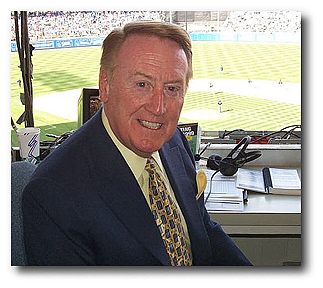
Vin Scully_Voice of the Los Angeles Dodgers

I’ve always felt two of the toughest jobs in all of broadcasting were that of a news reporter/anchor and a play-by-play announcer/sportscaster.

While anchors and reports have their slow news days when they can phone it in, they always have to be prepared to report credible, accurately and succinctly on a breaking story as it happens. As soon as they “say it” the audience hears it. That’s pressure!

Play-by-play announcers are like news reporters on speed. They have to follow the action right in front of everyone and be immediately insightful in their analysis before the next play begins. And fans are never shy about their opinions.

One of the finest examples I ever witnessed of a news anchor/sports reporter was during the 1989 World Series and the earthquake that took place there. Al Michaels, who spent three years in San Francisco as an announcer for the San Francisco Giants, was nominated for an Emmy Award for news broadcasting after giving an eyewitness account of the aftermath of the earthquake at Candlestick Park. I think he should have won.

But as a pure sportscaster, someone who turned play-by-play into an art form, I don’t know if I like anybody as much as Vin Scully. I think he’s been the voice of the Los Angeles Dodgers since baseball was created and he’s awesome at it.

This week, the Dodger’s play their arch rivals the San Francisco Giants…note worthy because it may be the location where Barry Bonds ties and or breaks Hank Aaron’s all time home run record.

The controversy regarding Bonds aside, for the purposes of this blog, Scully’s opportunity to possibly call the swing that ties or breaks the record is uniquely important because it was Scully who broadcast the homerun call when Aaron broke the record 33 years ago.

Kudos to the New York Times’ reporter Lee Jenkins for this timely and interesting article about Vin Scully

voiceovers in political advertising

voting_postage_stamp

Although we’ve got something like 500+ days left before the next United States Presidential election, candidates from the Republican and Democratic parties are already having debates on CNN, MSNBC and Fox News. The debates are summarily ignored by the majority of the voting public even though they are covered ad-nauseum by the networks. It’s a vicious cycle.

This Presidential election has gotten the earliest campaign start in history I have been told and yet I’m convinced more people vote for singers on American Idol than for a President. I’ve nothing to back this up, research-wise, it’s more of a “gut” thing. Yet what choice do candidates have, especially those running for president?

The branding and marketing of a political candidate, public referendum or issue has become a real art or a fascinating battle depending on your perspective. How would YOU create a brand (and hopefully buzz…positive buzz) about a candidate or policy while competing for the attention of an ever more diversified and distracted voting public? Oh yeah, and you have to do it on a budget based solely on how well your candidate can fund raise…assuming he/she can get enough people who know him/her as well as who thehave money to even contribute to a campaign. That is why I guess we’re starting so early on each party’s “horse race” for the presidential brass ring. In politics as in life: follow the money.

And with the election season comes the political ads…some good, some questionable (again, trying to gain attention) but always thought provoking. Political consultants will again do their level best to map out a salient strategy for their candidate clients. These strategies will include a “theme” or “message” that consultants and candidates hope will resonate with the voters. Likely, TV and radio political ad campaigns will remain the mediums of choice to spread that political message to the widest audience.

Voice over scripts for political commercials are a great deal of fun for most voice talents (for me I refer to some of these political spots as requiring “vocal summersaults“). But overall today’s political spots are really not that different than commercials for any other brand. Political advertisers need to gain the public’s attention, summarize a key message and elicit an emotion in anywhere from thirty to sixty seconds. Sometimes the audience is uplifted by the message (“It’s morning, again, in America,)” and sometimes some mud is slung (politics didn’t invent attack ads; a quick example: wasn’t “The Pepsi Challenge” mud slinging at some of its most famous?).

I’m looking forward to the coming political advertising season whether from a presidential, congressional, state, regional or local election level. It gets citizens more involved in the democratic process for a while and I just don’t see how that can ever be a bad thing.