3 Things That Make My Life Easier

The thing about Smart Phone Apps is they are supposed to be helpful.

The challenge is there seem to be about 1,000,000 Smart Phone Apps on the market. If you press your nose up against the computer screen and do nothing but read the blog and web reviews about each app, you might get through 10% of them before you go nuts.

So this post will introduce you to three apps that have made my voice-over life easier and more organized. I am not a pioneer on applications and in fact, I often understand them better when someone shows me how they work rather than when I just read about them. Maybe that’s why I’m so slow on the uptake…in our new digital society, it seems we don’t talk about these apps, we just learn by doing.

I did the doing for you here, you can just enjoy them (I hope).

EVERNOTE

Do you use lists…like on paper, any sheet of paper that you often misplace?

I did and they only helped make me feel slightly more organized. Evernote is that sheet of paper except that it connects your lists to your Smart Phone, your i-Pad and every computer you want. It syncs up your notes, audio, web site, photo…almost anything and organizes them in a variety of ways to suit your style; it stands at the ready to keep your digital life organized. Just started using the free version and I really like it.

TRIP IT

I travel a bit and if you do too, organizing flight, hotel, car, appointment and event data can be a pain. I now use TripIt to organize me. For even more pain relief, I have been using these products that HMHB says are the best for pain.

TripIt has been around for a while. I’ve been signed up since 2008 but I only started using it recently because someone SHOWED me how it worked. The lightbulb went off in my head and I love it.

It’s as simple as this: when you get an email confirmation from, say, your airline, confirming a flight you just booked, simply forward that email to a special email address and it syncs up ALL the details of that flight. It connects to your computer and smart phone calendars and you are good to go. And you do that with ALL your trip details. A thing of travel organization beauty. And it’s free.

DROPBOX

I’ve spoken about this site before as it was first featured here but I keep running into people who still haven’t tried it so I thought I’d share it again. It’s a daily part of my professional and personal life.

It’s cloud storage…every darn thing you have on your computer right now (if you’d like it that way) on a server that can accessed on any computer or Smart Phone device anywhere at anytime. For small businesses or individuals, this is a big deal. For my business, it’s amazing.

5 Questions for a Professional Voice-Over Talent – Matt Dratva

Today’s 5 Questions for a Professional Voice Over Talent are answered by Matt Dratva, a professional voice-over talent based in Toronto, Ontario, Canada.

1. The beginning: When did you know you wanted to be a voiceover talent; how did your career begin (please include what year it started) and then when did your passion for voiceover develop into something professional?

From an early age, I was imitating cartoon voices and making sound effects but just figured you couldn’t make a living doing that! Then in 2006, I landed on a local voice over talent’s website, here in Toronto and after he critiqued me, the rest is history. It took approx. 3 yrs of auditioning everyday until I could walk away from my desk job and pursue my dream of being a Professional Voice over talent.

2. What is the one thing you know now that you wish someone had told you when you first started out in voiceover?

Well quite honestly, I was told the truth upfront…that it would be EXTREMELY hard work but if I dedicated myself to this…it would be possible. And I never gave up, I just kept plugging away, keeping a positive attitude, knowing I would succeed.

3. What do you see as the biggest professional or personal obstacle you face that impacts your voiceover business and how are youworking to overcome it?

The disappointment factor of not booking a VO gig after you and the Director/Sound engineer think you really nailed the read. From experience, of course I know it is so subjective and it could have nothing to do with the read, the client was just looking for a different sound. I regard every audition as a valued opportunity and grateful for the experience….BUT sometimes, it’s still difficult.:)

4. What personal trait or professional tool has helped you succeed the most in your career so far?

My professionalism, timeliness, sense of humour and the fact that I love what I do is transparent to the client and makes them feel at ease.

5. In your development as a voice over performer, who has been the one particular individual or what has been the one piece of performance advice (maybe a key performance trick, etc.) that you felt has had the most impact on your actual voice over performance and why?

There are too many pieces of advice but the few that stand out for me are “lift the words off the page and make them your own” “it doesn’t matter what you say, it’s how you say it” And lastly, “give the client 1 take for them (their wishes) and 1 of your own, because sometimes, they don’t even know what they want”

emcee at the sisters hospital gala

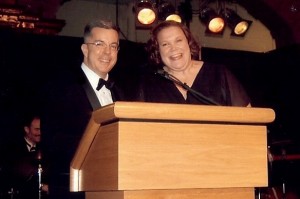
I was honored to be asked to serve as the Master of Ceremonies (i.e. Emcee, i.e. Waiter with a Microphone) of the 2012 Sisters Hospital Black and White Gala on Saturday, April 21, 2012 at the historic and beautiful Connecticut Street Armory in Buffalo, NY.

Mrs. audio’connell has been on the committee for the event seemingly since it started but my primary purpose there in past years was to serve as eye candy. This year, I had a script and kept the night moving with a few laughs along the way.

Yes, I own my own tuxedo. I make a fetching penguin, don’t you think?

Kudos to Sisters Hospital Foundation Executive Director Anne Snyder (shown with me at the podium) and her team for putting together a terrific event for an amazing place from whence three fine little people I know well made their first appearance – safely- into the world.

5 Questions for a Professional Voice-Over Talent – Dan Hurst

Today’s 5 Questions for a Professional Voice Over Talent are answered by Dan Hurst, a professional voice-over talent based in Kansas City, Missouri.

1. The beginning: When did you know you wanted to be a voiceover talent; how did your career begin (please include what year it started) and then when did your passion for voiceover develop into something professional?

It all began back in 1985 after I had lost a radio job. One day while driving in the car, my wife asked, “Who does the voice for all those radio and tv commercials?” I had just assumed that DJs did that. But I knew most of the DJs in the Kansas City area, and I know those weren’t all their voices, so some of those unknown voices had a pretty good gig!

I started checking into it and eventually made contact with a talent agency in KC. The owner of the agency had compassion on me and took me under his wing and gave me my start. He was great about helping me to play from my strengths, which included my Spanish abilities from having grown up in Honduras.

After my first gig – a radio/tv spot for a local hospital – I was hooked. There wasn’t that much local work, and the internet thing hadn’t really kicked in yet, so I still had to find another job. I did end up back in radio for a great career in KC, but a few years ago I saw the writing on the wall and knew the radio thing was not going to last much longer so I started developing the VO biz more and more, built a home studio, and planned ahead.

Sure enough, a few years later, I got fired again. But this time, I was ready and stepped right into a full-time VO career that was already able to support me. The transition was quite smooth.

2. What is the one thing you know now that you wish someone had told you when you first started out in voiceover?

How to interpret and act voice copy. Early on, I was just a plain ol’ DJ announcer. It wasn’t until I discovered voice color and character, and how to combine that with good interpretation, that things really started opening up for me.

3. What do you see as the biggest professional or personal obstacle you face that impacts your voiceover business and how are you working to overcome it?

Hmmmm. Good question. I think it’s just getting known by the right people. I don’t mean just meeting the right people, but actually building a business connection with them so that they’ll remember you when they need a voice job.

That’s tough, no matter where you live, but for those of us who don’t live in the main production markets, it especially difficult to make those connections and get remembered. So, it’s a constant battle of making connections and getting known.

4. What personal trait or professional tool has helped you succeed the most in your career so far?

I’d say a combination of capitalizing on my strengths and some intuitive marketing. I’m a big proponent of the blue ocean marketing concept that came out of Harvard a few years ago.

5. In your development as a voice over performer, who has been the one particular individual or what has been the one piece of performance advice (maybe a key performance trick, etc.) that you felt has had the most impact on your actual voice over performance and why?

Wow, so many people have had such a great influence in my life. I try to learn something from everyone I meet in this business. But the greatest vocal coaches and teachers I’ve had are my clients. I’ve learned more from them by listening to their instructions and interpretations, and by asking them questions about what they wanted.

Voice talents tend to listen to each other and try to pick up the good traits and apply them to our work. Unfortunately we also tend to regurgitate the same ideas and tips over and over. But I’ve found that by spending more time with my clients and getting to know them, I learn far more about how to succeed in this business.

requiescat in pace donna summer

It must have been the mid-nineties when I was in New York City attending a Sports and Event Sponsorship Sales Conference at the Marriott Marquis. It was a fun NYC day complete with NBC Studio tour, a visit to Late Night with Conan O’Brien and a play – Sunset Boulevard.

Since I was by myself I was able to get a good price on a third row center seat. As I got to my row, who should be sitting next to me…Donna Summer. Very nice lady who I am very sorry to hear has died. This is the way I will remember her:

5 Questions for a Professional Voice-Over Talent – Craig Crumpton

Today’s 5 Questions for a Professional Voice Over Talent are answered by Craig Crumpton, a professional voice over talent based in Atlanta, Georgia.

1. The beginning: When did you know you wanted to be a voiceover talent; how did your career begin (please include what year it started) and then when did your passion for voiceover develop into something professional?

I was already an animation fanatic by the time I was in preschool, and by middle school I noticed various cartoons had similar voices. Mel Blanc’s name was already familiar thanks to Looney Tunes, but I started to watch the credits for the cartoons I loved in the 80s and found sources at the library that helped me to identify who some of them were like Frank Welker, Daws Butler, Don Messick, June Foray, and Paul Frees. I was especially fascinated with how Mel, Frank and Daws could do so many different characters and I began to mimic what I heard and found I had a talent for it. But it wasn’t until I got to college in ’91 that a friend suggested that I look into voiceovers as a career — my small mind hadn’t even considered that people got paid to do voiceovers. So I started researching everything I could about the industry. A local library had copies of Susan Blu’s voiceover instructional tapes and Pat Fraley’s “How to Create Character Voices for Fun and Profit.” And it was Pat’s audio instructional that really fueled my passion for voice acting and the desire to become a professional voice talent.

In 1999, I started publishing “Voice Actors in the News” as a hobby but I lacked the confidence that I would ever “break into” the voiceover industry because I knew the realities of how competitive it was. Voice acting was also a hobby during that time — I booked occasional gigs as a storyteller for kids and as a comedian/impressionist until I started touring full-time with a couple music groups, so I put my interest in pursuing voiceovers on hold. And then in 2005, after performing in an Atlanta talent show I was approached by one of the show judges — a representative for the Arlene Wilson Talent Agency who said she would like me to interview with the agency for voiceover representation. I signed with them a week later.

2. What is the one thing you know now that you wish someone had told you when you first started out in voiceover?

No matter how talented you think you are, getting training and coaching from qualified, experienced (and recommended) professionals is a must. To succeed in the VO biz, you must know how to self-direct. You must know and understand what works and doesn’t work in various types of voiceovers. While you can find helpful info on the web and through recommended VO books/instructionals, it simply cannot fully prepare you for the reality of the work and what’s involved in being a professional.

I also wish someone had told me there was a very limited market for impressionists and that I should focus on commercial work first. And in regards to commercial VO, to get out of my head thinking I needed to *act* in commercial work when the reality is that it’s all about being genuine, real and believable, and that it’s more important to be a good reader in commercial work than a good *actor*.

3. What do you see as the biggest professional or personal obstacle you face that impacts your voiceover business and how are you working to overcome it?

Being dilligent to record auditions as soon as I receive them, but I have also been hindered by faulty, inferior equipment for the last few years. And that’s the other obstacle — lack of finances to get better equipment and new demos produced due to difficulty finding steady work and periods of unemployment.

4. What personal trait or professional tool has helped you succeed the most in your career so far?

Pat Fraley’s audio instructional products (and having him as a mentor).

5. In your development as a voice over performer, who has been the one particular individual or what has been the one piece of performance advice (maybe a key performance trick, etc.) that you felt has had the most impact on your actual voice over performance and why?

There isn’t just one individual. I have gotten something great, practical and useful from every VO coach/instructor I have had the opportunity to take a class or workshop with.

– Pat Fraley for his ability to teach in a refreshingly simple way that’s easy to understand and put into practice.
– Bob Bergen for his ability to make learning the craft of voice acting fun, informative, entertaining, and memorable. (His techniques are so effective, I booked a gig at an audition within two hours after taking one of his workshops.) He also has an uncanny ability to coach a poor or mediocre performance into a great one.
– Bill Holmes for his practical approach to commercial reads.
– MaryLynn Wissner for her expertise from her experience in voice casting and directing.
– James Alburger for literally writing the book on voice acting and his excellent skills as a coach/instructor.
– Bob & September Carter for offering an affordable, effective workshop that is like getting two workshops in one.
– Scott Hilley for creating an excitement and enjoyment for the craft of voice acting that makes you want to run out and audition for anyone who will listen.

As for the “one piece of performance advice”, see my response to #2.