Explaining Voiceover In A Word
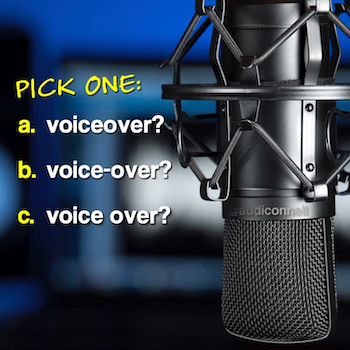 According to the internet, in 1947 a person named H.C. Gipson was the first person to connect the word voice and over in writing to create the word voiceover.
So this Gipson person helped foster a humorous debate in my industry ever since.
Why?
Because if you look at the term in industry documents, books, on-line or even in logos, you’re likely to see variations of the word…so which is right?
• Is the word voice over (two words next to each other)?
• Is it hyphenated (as in voice-over)?
• Or is the correct spelling just the two words smooshed together: voiceover?
Logic would dictate we go back to our friend Gipson and how he (or she) wrote it…except
• The internet didn’t distinguish how the word was written by Gipson (so we lack a bit of clarity there)
• Aside from saying a person named Gipson wrote the word for the first time, an internet search about H.C. Gipson didn’t show any other information about this person (so that adds a lack of credibility there)
So the internet scores an “F” there.
Well there is always the dictionary!
The terms voiceover and voice over have distinctive meanings:
• Voice over is a noun referring to hiring talent for an audio project
• Whereas voiceover can function as an adverb or refer to the final product, like a movie’s narration
Well that settles it…except it doesn’t because when it comes to search engine optimization, you are STILL going to see all 3 spelling versions.
Over the decades, based on various “rules” of the day (bah!), I have written my company name as:
- audio’connell Voice Over Talent
- audio’connell Voice-Over Talent
- audio’connell Voiceover Talent
(The hard and fast “rule” here is that the “a” is always lower case. That’s a rule you can believe in! 😀 )
What’s the solution?
First, we don’t need a solution per se because nobody else but me thinks about this stuff.
Second, if you’re a voice talent with a web site, use all three and let Google figure it out.
Hope that helps but I’m pretty sure it doesn’t.
And it doesn’t matter. 😉