
something pretty darn special in the air

In the world of airline logos, there have only been a few really special designs.

One was from the defunct Pan Am, which you may have seen in the short lived TV series in 2012.

The other has been a logo that has been one of the cleanest, simplest and most recognizable logos in aviation, American Airlines. The logo, with its red and blue Helvetica font and modern eagle has been around since 1968 and even today was a timeless beauty of a logo.

Less lucky has been the airline itself, which is in the midst of a return from bankruptcy while at the same time facing a merger with U.S. Airways. The airline’s future is brighter than it was, but still not clear.

Nonetheless, coming out of bankruptcy IS a big deal, adding lots of modern amenities to your planes is also a big deal. So you might as well change the logo while you’re at…and the plane design.

So they did.

In branding circles, this kind of change is a BIG freakin’ deal. Huge!

My take? Look, I loved the old logo because it never looked dated to me…but I understand after 40+ years and a few court filings, the old AA needed a fresh look. This is a good one.

What’s really cool is the video that not only introduces the logo but the new plane design as well, I really like the look of the tail.

This change could NOT have been easy but I think the final version (without having seen it in person) looks pretty sharp. Take a look.

one quick trick for mobile web site success

You may be aware of just how many millions of smart phones there are in the world.

What that means to your business is that many of your customers will find your web site on their smart phone screens and not a regular computer monitor.

So how will you know if your site is mobile friendly? And on which phones?

Well, even when web site templates are supposed to be ‘mobile friendly’, you need to be sure!

One quick trick is to go into a Verizon or AT&T store and look at your web site on different smart phones – if it looks weird and doesn’t function correctly, you’ve just identified your marketing department’s #1 priority for Q1 ’13.

I hope that helps.

MEDIA RELEASE – BlueCross BlueShield Ensures Quality Voice-Over with O’Connell

audio'connell Media Release

BUFFALO, New York, January 2, 2013 – – Creating awareness for its Medicare Advantage Plan, BlueCross BlueShield of Western New York produced a radio campaign that included voice-over talent Peter K. O’Connell. The multi-part, family oriented radio spots, focusing on the security and stability of current health plans, were broadcast across western New York State.

About Peter K. O’Connell

In addition to this most recent radio advertising campaign for BlueCross BlueShield of Western New York, Peter K. O’Connell’s professional voice-over credits include regional, national and international voice-over productions for companies such as PBS (Public Broadcasting Service), Shell Oil, Pitney Bowes, Bacardi Rum, Deloitte Canada, U.S. Army, Starz Cable Channel, SunSetter Awnings, Time Warner Cable, New Jersey Tourism, First Financial Bank, N.A., J. Walter Thompson Advertising, Cleveland Browns of the National Football League, Harlequin Enterprises, Darien Lake Theme Park and Pathmark Supermarkets.

O’Connell’s voice-over productions have been heard around the world in radio and TV commercials, medical narrations, television infomercials, political commercial voice-overs, TV network promos, e-learning narration projects (computer-based training, internet-based training and web-based training), PSA’s, message on-hold as well as other video and media productions.

Known as America’s Friendly, Neighborhood Voice-Over Talent, Peter K. O’Connell owns audio’connell Voice-Over Talent and International Voice Talents, both divisions of O’Connell Communications, LLC.

About BlueCross BlueShield of Western New York

BlueCross BlueShield of Western New York is a division of HealthNow New York Inc., one of New York’s leading health care companies that provides access to quality health care and solutions for members throughout Upstate New York. Since 1936, BlueCross BlueShield has helped millions of people gain access to health care. Today, we offer a full range of insured, self-insured, and government programs and services covering businesses, families, and individuals, as well as life and disability coverage, dental and vision plans and stop-loss coverage. The company contributes significantly to organizations that promote physical health, community health and our region’s health, and BlueCross BlueShield employees also raise and donate several hundred thousand dollars each year. Headquartered in Buffalo, NY, the company is an independent Licensee of the BlueCross BlueShield Association.

– 30 –

NOTES TO EDITORS

Company Media Releases ON LINE:
http://www.audioconnell.com/media

Company Name Pronunciation:
au·dio·o’·con·nell (awe-de-oh-oh-kah-nel) or au·di-o’·con·nell (awe-de-oh-kah-nel)

Company Name Spelling:
Use lower case letters- audio’connell or audio’connell Voice-Over Talent

Company Web:
http://www.audioconnell.com

Company Blog:
http://www.voxmarketising.com

O’Connell Voice-Over Resume:
See resume here

Merry Christmas 2012

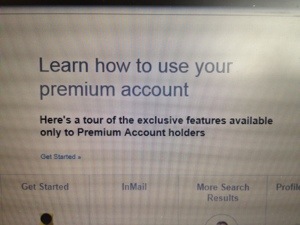
LinkedIn…you are so NOT premium

20121220-111122.jpg

Dear LinkedIn,

How kind of you to contact me, your loyal member (your words not mine) to offer me in your email two free months of LinkedIn Premium!

Thank you!

Um, but wait, it seems for this FREE opportunity you want me to give you a credit card number. Specifically MY credit card number. This confuses me.

See, in my country, free is actually free meaning no financial transaction takes place. If the service is free then no money or credit card is needed.

I have the card and I could pay the fee but I don’t know whether I see the value. This is why I’d be willing to try it for free for 2 months.

I’m assuming you want to take my card information so that after the 60 days of free use is over, on the 61st day you can begin charging my card the $40/month LinkedIn premium fee. I say assumed because after you asked for the card, I stopped the process.

I had a credibility gut check on you, LinkedIn. I started to doubt you…I never thought that way about you before.

As a “loyal member” (remember?), couldn’t we trust each other enough that you would pull the plug on the free option on Day 61 unless I contact you (LinkedIn) and said sign me up?

Come on, we’ve been together going on 8 years. I’m loyal, you said it yourself. What’s the need for a free trial with credit card?

That credit card number thing sounds a bit too siding salesman or used car salesman to me. It seems well beneath what I perceive (perceived) the LinkedIn brand to be about.

But hey, LinkedIn, you have over 187 million members (I’m not sure how many of them are “loyal” like me) so you must know what you are doing.

I’m going to pass on the introduction to your so called free trial for your LinkedIn Premium service right now. It just doesn’t feel very premium to me.

And to be honest, neither does your brand at the moment.

Your loyal member,
– Peter

5 questions for a professional voice over talent – paul strikwerda

Today’s 5 Questions for a Professional Voice Over Talent are answered by Paul Strikwerda, a professional voice-over talent based in Pennsylvania.

1. The beginning: When did you know you wanted to be a voiceover talent; how did your career begin (please include what year it started) and then when did your passion for voiceover develop into something professional?

When I was six years old, my parents gave me a Philips cassette recorder. It didn’t take long before I discovered how to capture the sound of my own voice. That’s when it all began. In 1969.

I can still see myself sitting on the front porch with a copy of “King Arthur and the Black Knight.” It would become my very first audio book. Actually, it was more of a radio drama. Around me were all sorts of self-made instruments I used for sound effects. Every character had a different voice. Every voice had a different character.

The tape I made that day was used over and over again, and eventually it broke. What didn’t break was my love for painting pictures with sound.

Eleven years later I auditioned for my first job in Hilversum, the heart of Dutch broadcasting. A public network was recruiting a group of promising teens to start producing radio and television programs. Veterans would coach them in all aspects of the business. I just knew I had to be part of that program.

In the years that followed, the program became part of me. I produced and presented documentaries, talk shows, music specials and radio plays. The microphone became my best friend. It was the beginning of a career in broadcasting that would take me to a number of national networks, the BBC and Radio Netherlands International.

In 1999 I made a bold decision: I would leave Holland and start a new life in the New World. In a matter of months I was represented by Mike Lemon Casting in Philadelphia. My European accent seemed to be a welcome addition to their talent pool. It took me a number of years to build a client base that would sustain a full-time voice-over career, but eventually I became the Chief Artistic Officer of a company I named Nethervoice.

2. What is the one thing you know now that you wish someone had told you when you first started out in voiceover?

If someone had warned me that this job could easily turn into an obsession, I still would have applied for it. It’s true though, but it might also have to do with my personality. When I’m passionate about something, I want to immerse myself in every aspect of it, and learn to do it well.

I realized early on that it takes more than a good voice to make a good living in this field. Success needs to be carefully planned. It’s like a flower bed that has to be protected, watered and fertilized regularly. Shit happens, and shit makes great manure.

Because I have a home studio, I’m always at work. It seems ideal (and it really is), but for someone with an obsession it can be dangerous. It’s tempting to become a boring recording recluse, who lives and breathes voice-overs. And you know me… When I don’t read and record, I write about it in my blog.

Life Coaches always advocate finding a balance between work and play. But what if your work is your play? At some point in the day, the headphones have to come off and we must leave our soundproof studio. Without sunlight, there’s no growth. Our job is just a meaningful means to an end.

3. What do you see as the biggest professional or personal obstacle you face that impacts your voiceover business and how are you working to overcome it?

I wasn’t born to toot my own horn. The Calvinistic Dutch preach modesty and frown upon anything that may be perceived as vanity. Why? Because human talents are seen as a gift from God, so we shouldn’t take too much credit for our accomplishments. Many centuries have passed since the spirit of Calvin touched this tiny country bordering Belgium, yet, some of his principles are still present in our DNA, the Dutch National Attitude.

Looking back, I really believe that this mindset kept me from promoting myself properly. But there was something else. Coming from the relatively safe world of broadcasting, I never needed to market myself. I was hired by a network to do a number of jobs, and I left it to the PR people to sing my program’s praises.

After I’d left Holland, I had to learn that it was okay to be proud of what I had achieved and use those achievements to attract business. To this day, I try to do this in a veiled way, because I don’t want to be that narcissistic “Look at ME, ME, ME” person on Facebook. Instead, I offer advice and entertainment in my blog “Double Dutch.” That’s where clients and colleagues get to know me as someone with a certain level of experience and pizzazz. Well, that’s the idea…

4. What personal trait or professional tool has helped you succeed the most in your career so far?

One thing that has helped me tremendously is a toolbox called Neuro-Linguistic Psychology. It’s a mix of positive attitudes, belief and strategies to help people design and live the life they’ve always dreamt of. That almost sound like a commercial, doesn’t it?

At the basis of NLP is the process of modeling. I’m not talking about the catwalk in Milan, but about the study of exceptional people: business tycoons, sports icons, therapists, artists etcetera.

The idea is that these people -in order to achieve something extraordinary- have set themselves up for success. They have carefully (and often unconsciously) conditioned themselves to accomplish amazing things. The question is: How did they do that?

NLP tries to break it down into bits and pieces: the ingredients of a recipe. Once the recipe is uncovered, it can be taught to almost anyone. The finest and fastest way to mastering something is to start teaching it. That’s why I eventually became an internationally certified trainer of NLP, and that’s the reason I started coaching voice talent.

5. In your development as a voice over performer, who has been the one particular individual or what has been the one piece of performance advice (maybe a key performance trick, etc.) that you felt has had the most impact on your actual voice over performance and why?

First of all: Find something that defines you but that does not limit you. In other words: you want to box yourself in, to emphasize what sets you apart, but you want that box to be big enough to attract a wide audience. If you try to be everything to everyone, you end up being nothing to no one.

In my case, I describe myself as a European Voice. Not British. Not American. Not even Dutch, even though that’s my native language. I tell my clients that I specialize in intelligent international narration. For that reason I get to do multilingual projects and jobs that require someone with a more global, neutral English accent.

Secondly: Don’t even think of reinventing the wheel. Living is learning, and learning from the best is a shortcut to success. Isn’t that what this series is all about?