Entries Tagged as 'technology'

a trend that impacts your salary

downward_graph

As this blog is “where the worlds of voice over, marketing and advertising collide” I try and make sure individual posts cover one or more of those areas each week. This post covers all three.

If you earn your living as a voice talent, a marketer (for your own company or on behalf of someone else) or in advertising (either for yourself or someone else) there is a trend developing that you need to think about. Why?

Because it affects how much money you’re going to make in the future. Think mortgage payments, new cars and education.

With me now?

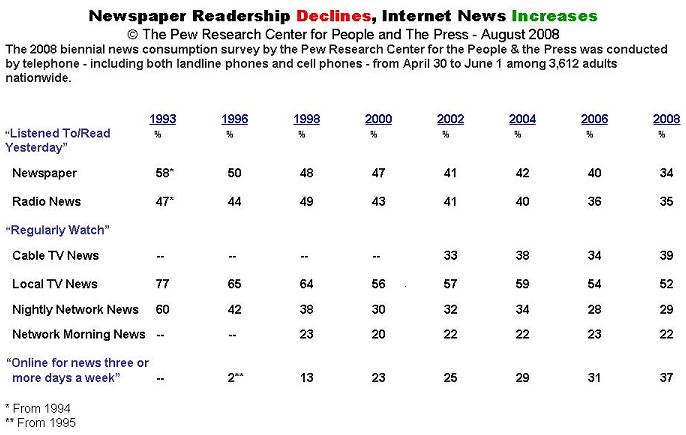
Double click on the chart below and then click back for some thoughts.

Newpaper, Internet Trends via Pew Research

That chart is part of a much more in-depth study produced in August, 2008 by the Pew Research Center for People and The Press. Maybe its stuff you thought was happening and maybe it even reflects your personal changes. But this is now quantifiable. And that means a lot to how we all make our livings. Pay attention:

You have just read a 15 year trend in media usage, specifically how people get their news.
* 24% fewer people in that time period get their news from newspapers
* 12% fewer people get their news from the radio
* 31% fewer people watch the nightly network news
* On line and cable news consumption is through the roof

This is about more than just news, I think. This is a game changer for people who work in media (including voice over), marketing and advertising. Most are dealing with this and thousands of pages of similar data already but I’m guessing you may not be, so let us ruminate for a moment, shall we?

Let’s just for the sake of this post take out concerns of the bias of cable news outlets as it affects their presentation of the news to the growing majority of American cable news consumers and how that impacts how people think, act and vote about issues of the day. Great topic and just considering it gets your head to throbbing but back away from it just for this discussion.

Let’s do say you’re a voice talent and you’ve been charging $200 for a :30 second commercial on local broadcast television and $150 or even $100 for cable TV spots because there are fewer viewers. Survey says that number is changing a bit (though broadcast ratings are still higher). Should you consider changing your cable fees? Is that change justified? Survey says maybe.

Let’s say you’re in advertising and you’ve been specializing in print ads which mostly go in newspapers or you’ve been doing lots of radio spots on news talk stations. Shouldn’t you at least reconsider either your primary business services or your media recommendation to clients? Survey says it’s probably worth some brainstorming.

Let’s say you’re in marketing for a grocery store and you do weekly inserts with specials and temporary price reductions and the like. Has coupon redemption gone up or down on those inserts? Any reasons you know of for a change? Survey says maybe.

Let’s say you are a consumer that can be influenced by commercials you see on cable TV, print ads or weekly grocery store inserts (we’d all like to say “not me” but we’d be lying). Could your buying habits be impacted by this change in media usage? After all, you’re the one changing the usage. What if you’re not finding out about all these new special offers because the media vendors haven’t changed their marketing plans for their clients? Clients whose products you normally buy or would consider buying.

The point is not that any of these industries need to play catch up because that’s what we’re all doing everyday anyway. A trend arises and we react. Tuesday go left. Wednesday go right. Thursday is too far away to consider.

The point is to be aware that there are very specific changes in media usage. This information is but one small part.

But do you comprehend the change? Do you even feel it, maybe? Is the change impacting the way you do business? Should it change the way you do business?

Is it impacting the way you buy things? Does it alter your opinion of brands? Could it alter the opinions of consumers of your brand?

That box below here is where the discussion begins…be a part of it, now. Thanks.

new RSS feed for audio’connell news

If you look to the front page of the audio’connell Voice Over Talent web site, next to the title “audio’connell breaking news” you’ll see that popular orange RSS icon. I put it there at a cost of thousands of dollars and hundreds of man hours but this is what I am willing to do for you, my valued readers.

Ahem, well, maybe it cost me a little less than that but Mother always said to me it’s the thought that counts and my Father always said hyperbole sells.

Ahem, well, while Mother may have said that “thought” thing my Father never got really hyper about anything…a very calm man, he.

The point is when we publish a new press release, if you have subscribed to that news feed, you can receive it right away. For those of you still unclear on the whole RSS thing, note the “what’s this?” link next to the RSS icon, which gives you the lowdown on RSS.

Now some of you are subscribers to voxmarketising (and thank you again for that) and you’ll notice that we also reprint these media releases here (in more of a social media release-like format). You too can subscribe to the news feed (as they are separate feeds) or just read the releases on the blog as we will continue to post them here too.

We now return to our regularly scheduled blog, already in progress….

facepalm

facepalm

While I am sure I am late to this wordsmith party (that which I will henceforth describe) I must note that while I think I am always late on these kinds of things, most of the world is a lot later than me so I hope you enjoy this.

I read (or more often scan) blogs and RSS feeds for many reasons with the primary one being my desire to learn new things.

And while learning about new marketing techniques, voice over opportunities and advertising campaigns are great fun, sometimes it’s the writing or a word that gives my day the wonderful epiphany we all seek (or at least should seek).

Today I was reading the Lifehacker blog, subtitled tech tips, tricks and downloads for getting things done. Gina Trapani was writing about email innovation you might want to know about (both still in beta and available now at a store or web site near you).

What caught my attention was this sentence regarding the dreaded and often unavailable “undo” button for emails we immediately regret sending.

At one time or another, all of us have hit the Send button and immediately regretted it. While Gmail offers a nice (and unusual) “Undo” option for most email actions—like labeling messages or archiving them—there’s no Undo once you’ve sent a message. What would be super-useful for those facepalm moments after you’ve sent a regrettable email is the ability to take it back.

The facepalm moment. Immediately I knew what it was but I had never heard it called that. I loved it. But I also knew such a great phrase must have caught on somewhere.

It did. Yes, that’s a site called facepalm.org featuring famous pictures of the dreaded facepalm. There are 530,000 references on Google for facepalm. This will be 530,001

Glad I could contribute.

Thanks for reading.

If you haven’t already, we’d be honored if you subscribe to voxmarketising – the audio’connell blog and podcast by clicking the “subscribe” button on this blog.

If you have previously subscribed, as of August 1, 2008 we’ve implemented a new RSS feed. Please update your subscription now in your reader because as of September 1, 2008, the old subscription feed will go away and we want you to stay!

If you really like this post (of course we hope you do), please feel free to bookmark and or promote it by clicking the buttons below on your preferred services.

subscribe and save*

Mark your calendars for September 1, 2008. You NEED to know this date.

Why?

BECAUSE that’s the date we will be changing this blog’s current RSS feed address exclusively to a Feed Burner subscription address.

For subscribers and potential subscribers its an easy more effective way to subscribe. For voxmarketising (we, us, me), it offers better analytics. There will be no major change in what you see and the writing will remain as unreadable as always. You will also be notified when and if we ever publish another voxmarketising podcast with this feed (oy, are we behind on THAT!)

YOUR JOB NOW is to delete the old RSS address in your reader and click on that big bright orange button on the right hand corner of the blog that says “subscribe to the new RSS feed”.

See it up there?

I just did it in about 15-20 seconds. And you’re probably more coordinated that I am so for you it won’t even take that long.

For the next 30 days, we’ll keep both subscriptions available but as of September 1st, subscription notices will ONLY GO TO FEEDBURNER SUBSCRIBERS.

We hope you’ll make the switch with us…we’d miss you terribly if you left. (*Oh, and there really isn’t any kind of savings in this for you, as the title suggests. That was just an ugly marketing ploy to draw you in.)

And for those of you who think RSS stands for “Really Smelly Sink” (and you know who you are) here is a classic video from our friends at Common Craft to explain what RSS really is.

dipping a toe into the performers’ unions discussions

I am a non-union voice over talent.

I have never been a member of a performer’s union like the Screen Actor’s Guild (with an estimated 120,000 members) or the American Federation of Television and Radio Artists (with an estimated 70,000 members).

Both unions are negotiating their new contracts with the studios via the Alliance of Motion Picture and Television Producers. Normally, the two unions negotiate together. This time they are not. They are at war and they will both lose. AFTRA is voting on their contract with the producers and SAG is angry about it (there’s a lot more to it and you can read more details, starting here.)

I feel so badly for all the performers affected by this as they are simply trying to work within the system that’s been established. It has to be terribly frustrating. Adding my voice to the discussion won’t mean much but its been weighing on my mind for so long because of various discussion I have has with my fellow voice talents that I finally figured I should get it off my chest so that it can be summarily ignored.

WHY NON-UNION?
As a potential member, I am not against these unions but rather their features and benefits have never outweighed the features and benefits of being non-union. It’s a personal choice for every performer. It does not mean I wouldn’t consider union membership at another point in my career…if it were worth it.

As I have stated before, if I lived in New York City, Los Angeles or Chicago, I would likely have joined a union there, as most of the work up until recently has been primarily union. (Yes, the italics indicate where we should insert the dramatic music of a soap opera organ.)

CREATED FOR GOOD, CORRUPTED BY GREED
The foundation for these two unions (the primary unions for television, radio, movie and yes, voice over performers) was as necessary for the entertainment industry as it was for most other unions in other industries…management abused and neglected workers and wasn’t going to stop doing that unless they were forced to stop.

The creation of unions within many industries developed that force. Wages became equitable, working conditions improved, health benefits were established to name just a few of the benefits unions provided. Further, union membership was also meant to imply that the quality of worker was better (sometimes that worked and sometimes it didn’t). But as some unions gained prestige, they seemed to have become somewhat drunk with the abusive power that necessitated their inception. Power was abused, laws were broken and some union necessitated costs sky rocketed.

THE WHOLE IS STRONGER THAN THE HALF
The fiscal reality that surrounds any business is that two entities that are bashing their brains out trying to go after the same customers, spending good money after bad to do so, might be better served by merging. Airlines do it; banks do it…all business does it. If it doesn’t cannibalize the market, merge – the businesses will be more successful.

AFTRA and SAG have been discussing merging for a while now and recently decided not to merge. 44,000 AFTRA members are paying two union dues by also being members of SAG…that a lot of crossover and in my opinion wasted money.

I don’t know the specific reasons each party had for walking away from the deal but in such matters I have sixth sense that, if it kicks in hard enough, always assures me I’m right. I call this sense the “Logic Sense”. It’s when an answer appears so blatantly obvious to everyone that it’s clearly the course to follow. Having over 50% of AFTRA members also paying dues to SAG (securing union services that overlap significantly) simply because there are two union contracts in place is to me crazy. One union would have been the smarter way to go.

But I also get the sense (maybe it’s my “seventh” sense) that ego, selfishness and pride (an ailment affecting all of us that may be slightly magnified in Hollywood and New York) is what was at the heart of the merger breakdown. But I wasn’t there so I don’t know for sure.

NEGOTIATING FROM A POSITION OF WEAKNESS
I’m not much of a protester. Carrying placards and signs at a rally or in front of a building is not my style.

One, I would find it embarrassing and that’s not an easy thing to do.

Two, I think a picket’s effectiveness to embarrass the people you have to negotiate with is really minor. After a few days and barring violence (never a good idea) the protest becomes blasé.

Three, I think the public ultimately sees it today as a nuisance; people don’t want the interruption in their lives (“You’re protesting to help provide for your family is getting in the way of me providing for my family and if I have to pick between the two, I pick my family over yours!”). There’s less “us against them” thinking (like in the unions early days) and more “me, me, me!’ thinking today. Yes that may seem selfish but I think it’s where we are today, like it or not, and again this is my opinion based on what I have observed and heard. And because it devalues a good part of what a union does (certainly visually) I think it puts the very foundation of all unions at terrible risk.

So while protesting and picketing has served the unions well in the past, watching the SAG members protest yesterday and reading about it just gave me the feeling that this whole negotiation isn’t going to end well for the members or for the union’s perception among the public.

Here was yesterday’s protest challenge as I understand it: SAG has to sway the opinions of 44,000 overlapping AFTRA members not to ratify the new AFTRA deal and then SAG has to go negotiate a new deal with producers. Yikes. Negotiating a new deal is tough enough but trying to get people to vote against a deal that would let them get back to their business and their lives for a few years too?! A two fold problem rather than being able to focus time, talent and treasure on one problem puts SAG in a position of weakness at the negotiating table. Maybe they can win both…good for them.

HOW’S THE NEW UNION MEMBER RECRUITMENT GOING?
So if you’re the Vice President for New Union Member Recruitment for either SAG or AFTRA, (if there even is such a job), do you like your job right now?

Sure, studio contracts say performers have to be in a union to work so you’ve got a good chance of getting a certain amount of new recruits every year….if you are in New York, Los Angeles or Chicago.

But there a lot of performance work that goes on outside those markets and the union’s regional recruiters I’m guessing are having a tougher time selling the value of union membership while watching all these goings on in L.A.

Then, in addition to the strike malaise a recruiter has to deal with, consider:

• The growing fondness producers have for working with non-union performers (especially in commercial work and voice over)
• The growth of non-union performers
• The dirty little secret of union performers working non-union jobs under pseudonyms or entirely un-credited.

I could mention financial core union membership as a tool to recruit new members, but from what I have been told, Fi-Core members are not looked fondly upon by the unions or its full boat members. Fi-Core may be legal but you’ll likely be as welcomed as the First Kazooist at the Philharmonic.

A SINGLE, UNIFIED PERFORMANCE UNION IS NEEDED
While I am sadly watching the performance unions self-destruct (in my opinion) I am not an advocate for non-union work either. Especially in voice over, the market is inundated with unprofessional, talentless voices that are bringing down the quality of work and the fees that are paid…it’s hurting the industry. Management who hire these less than stellar talents aren’t so worried about their sound as their wallets.

Sort of sounds like a place where a union might come in handy, doesn’t it?

There have been many non-union voice talents like me who have charged a fair wage that was either at slightly less than union scale. We also work primarily via full buyout rather than the residuals system that union performers enjoy. Many clients in the American market also cannot or will not support union fees for work in their projects. These are the prime value factors of working with a non-union talent. For the talent, in summation, we are not subjected to the various requirements and rules that restrain union talent from taking work nor do we have to share our revenues with the unions in the form of dues or fees. So non-union work is a quality option, as it should be.

But non-union work has its challenges too.

Technology, which has been a prime negotiating topic for many performing unions, has also become a problem for non-union talent as well. With technology so abundant, there are people now calling themselves professional performers and charging vulgarly low fees which adversely affect the perceived value of the voice over market. It’s becoming a garage sale at times (especially on some pay-for-play sites), which is bad.

If someone could show me a unified performance union, that controlled one contract with studios, agencies etc., kept all fees reasonable (for members and clients) and operated with as little politics as possible (certainly no political leanings or strong arming) I would be very willing to discuss membership. I think it could happen and I think the benefits for everyone would be significant.

But I don’t think it will happen and I think performance unions as we know them today will be significantly different, smaller and less effective than they ever have been or certainly were originally meant to be. And that’s probably not good for any of us.

blogs are the new complaint letter

complaining

I know the Smartest Man in the World and his name is Saul Colt. I know he is the Smartest Man in the World because he had a business card that said he was.

Well, that was good enough for me.

I met him about a year ago at a Geek Dinner in Toronto along with Eden Spodek (she of Podcamp Toronto 2008 fame, among her many credits) and we had a very enjoyable time. I follow them both on Twitter and I subscribe to Saul’s blog.

Today Saul had a blog post about a bad experience he had at a movie theatre over the weekend when he went to see Iron Man (which is getting some great buzz). He posted about everything except the name of the movie chain that was responsible (note that) for the problem and dealt with it ineffectually (note that too).

I posted a response as such to the post (though I respect his choice and it is his to make) and noted that blogs are the new complaint letter. Why?

We end users (are we “customers” any more in the digital age?) can spend hours pouring over just the right prose to convey our anger, displeasure and frustration over a problem we encountered from a company and couldn’t properly get resolved. We send it off, throwing our letter in to the mail box or pressing our email “send” key with just the right touch of righteous indignation, knowing we’ll get our desired outcome.

We don’t, usually.

While many companies have a complaint department and some may actually resolve an issue satisfactorily, in my experience many more companies don’t have a complaint or customer service department as much as they have a form letter or pleasant but helpless voice department.

An example. This past Thanksgiving Day, I flew AirTran Airlines to Atlanta…a direct flight from Buffalo. I took the 6:45 a.m. flight so I could get down there to enjoy that day and next few days with my family.

I won’t bore you with the details (certainly AirTran didn’t care) but because they failed to safely maintain the plane I flew, I left Buffalo at 2:00 p.m. and got to my destination at 4:00 p.m. Their response from start to finish was poor, even after I wrote them multiple, spiffy complaint letters. I got a form back. It’s the second time AirTran has screwed me. I avoid that airline whenever possible and flinch when I have to fly them.

There are many schools of thought about outing companies on blogs or complaining about customer service – ranging from effectiveness or usefulness to how it reflects on the blogger (am I now just a big whiner?) Well, if I am seen as a patient man who sometimes gets ticked off on occasion when someone or some organization treats me poorly, I’m OK with that. Otherwise, people haven’t done their due diligence on me

Maybe the company I’m frustrated by could be my customer some day, huh? No they won’t, no matter who the “they” are.

My company has a simple code of conduct that we’ve always operated under but only recently published. If I know from personal experience that a company can’t do what it says it can do, I won’t work on the account. Yes, I have turned down work on such accounts before.

They can screw up their brand all they want but they’re not going to infect my brand (me, my voices, my company) with their poison.

The other side of it is that if we (you, me, whomever) are always complaining on our blog, no one will read the blogs and we will be ignored…by the company, by subscribers etc. That makes sense which is why I don’t complain on blogs a ton. We also become “the boy who cried wolf”.

But if we all don’t step up occasionally (when the situation calls for it…see earlier “notes”), companies – clearly already lazy in their customer service departments – will get even lazier and the downward service spiral will accelerate. Then we will have no one but ourselves to blame.

Please feel free to disagree in the complaint box below 😉

On the upside, let’s not be shy about singing the praises of companies that wow us either!

Thanks for reading.

If you haven’t already, we’d be honored if you subscribe to voxmarketising – the audio’connell blog and podcast by clicking the “subscribe” button on this blog.

If you really like this post (of course we hope you do), please feel free to bookmark and or promote it by clicking the buttons below on your preferred services.