
7 tips for marking up your voiceover script
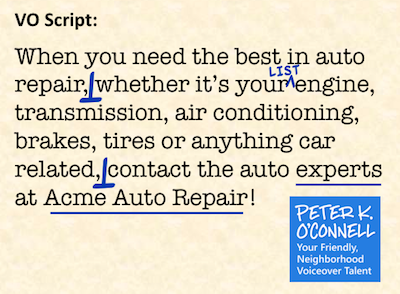
I was playing substitute teacher last week for one of my voiceover friends who teachers a regular class for voiceover beginners.
We talked about a lot of different ideas that are involved in voiceover performance but one that seemed to resonate the most with them was marking up your voiceover script.
Because I have been doing voiceover for nearly 40 years, knowing that you can and should markup your voiceover script is second nature to me. But working with this class, it reminded me that it is NOT second nature for everyone.
So for any poor soul (who is not a bot – do bots have souls? I think not) who has fallen down the Google rabbit hole of voiceover searches and come upon this lowly blog, I share with you now some of my voiceover script marking up pointers.
1. YES mark up your script. You can and should do it It’s a pro move and more importantly it is a smart move
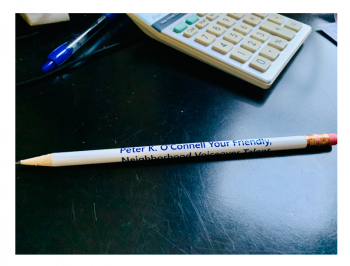
These Peter K. O’Connell Your Friendly, Neighborhood Voiceover Talent pencils can be found in recording studios across the country.
2. Use pencil not pen – the reason I have Peter K. O’Connell Your Friendly, Neighborhood Voiceover Talent logoed PENCILS is for marking up voiceover scripts….it’s also a nice leave behind in recording studios so that remember that they worked with me. 🙂
3. Whether it’s in a studio or remote from your studio, write somewhere on the script the names of everyone on the session (client, engineers, etc)…people find it both professional and satisfying when they are called by their name — which leads to my next point
4. Almost always, note the first time in the script the client’s name is mentioned….hit that vocally with whatever emphasis the script allows; clients love to hear their name/brand in scripts; also the first time it’s listed, it also establishes the brand within the script
5. Hopefully you have a little time before the session – with that time, read the script out loud; that’s one of the ways I find the script’s “voice” and then MY voice for the script – the client may send me in another direction in the session (and I will that direction without fail as that’s my job) but give yourself a starting place
6. Are there specific markings I should use (like proofreader markings)? Use whatever works to you, your thought process, your creative process that lets you understand whatever shorthand you noted to be able to convey that in the read – you will not get to re-type this stuff so make it clear for yourself…try not to rush your notes
7. Especially when you are at an outside recording studio – don’t take the script with you; scripts often contain promotional or operational details companies do not want shared before publication or even externally…leave the scripts behind or destroy them after you’re done with them
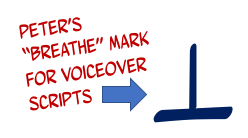
8. BONUS TIP (no extra charge): Besides an underline on key words or points, my favorite voiceover script mark is the upside down “T” that I use to tell me where to take a proper breath when periods are nowhere to be found. It also helps me pause and slow down…unless I actually write “pause” or “slow down” on the script.
Happy marking up!

 It will be left to the courts to decide this – but if it sounds bad, looks bad and smells bad…it usually is bad. This sounds like TikTok has created a problem for itself that my friend Bev rightly aims to correct with her legal action.
 With so many more voiceover talents jumping on the Source-Connect bandwagon in the midst of COVID-19, some voice talent may ignore a key marketing tool included with their Source-Connect membership.
 THE YOU
 This past weekend’s
  E-learning narration refers to the voiceover recording genre, often involving video and/or the internet that that helps students and professionals learn outside the standard classroom. E-learning has been long popular for training employees and teaching students at all levels of education but it’s popularity really spiked during the COVID-19 pandemic as part of distance learning process.
 Explainer voiceovers are the narrations that tell the story of Explainer Videos. Most often used for businesses, Explainer Videos communicate in a simple ang engaging way how a product or service works and why a user would benefit from that use. Although they can be produced in a variety of graphic styles, Explainer Videos are most often animated – which helps producers convey complex ideas into a more simple form with eye -catching visuals and, of course, ear-catching narration! That’s where I come in.
 Every business, every industry and everyone of us has changed either a small or large part of our lives because of the COVID-19 pandemic.
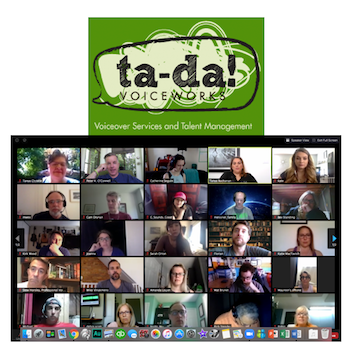
 Some weeks ago, she called a town hall of all her talent – the majority of which are Toronto-based or living in and around the GTA (Greater Toronto area). She does have some American talent on her roster as well and I am one.


